Login/Register My ordersMy ticketsMy wishlist Compare
Garden Center & Plant Nursery in Willis, TX | The Growers Outlet
0
Shopping cart
You have no items in your cart
Setting
Language
  • English (US)
Currency
  • usd
  • Home
  • Local Honey
  • ALL PLANTS
    • Landscape Plants Category
      • Bedding Plants
      • Crape Myrtles Category
      • Hanging Baskets
      • Native Plants
      • Ornamental Grasses
      • Perennials
      • Roses
      • Shrubs
      • Trees
      • Vines
    • Tropicals
      • Bougainvillea
      • Hibiscus
    • Edibles Plants
      • Berries
      • Citrus
      • Fruit Trees Other Than Citrus
      • Herbs
      • Peppers & Other Veggies
      • Tomatoes
  • Fertilizers & Solutions
    • Synthetics
      • Synthetic Fertilizers
      • Synthetic Amendments
      • Synthetic Insecticides
      • Synthetic Fungicides
      • Synthetic Herbicide
    • Organics
      • Organic Soil Amendments
      • Organic Fertilizers
      • Organic Insecticides
      • Organic Fungicides
      • Organic Herbicide
    • LAWN FERTILIZER
      • SYNTHETIC LAWN FERTILIZER
      • ORGANIC LAWN FERTILIZER
  • Bagged Mulches and Soils
    • MULCH
    • SOIL AMENDMENTS
    • SOILS, READY TO USE
    • GRAVEL & ROCK
  • Catalog
  • Home Page

Rose, Black Spot

Home Rose, Black Spot
Rose, Black Spot
Rose, Black Spot

Rose, Black Spot

Add your review
$0.00
Quantity
+ -
Add to cart
Add to wishlist Add to compare
  • Information
  • Reviews (0)
  • Share
  • Tags

Black spot is one of the most common and destructive rose diseases that we see in Texas. Some roses are resistant to the disease but all species and cultivar are affected. Defoliation, decreased quality and quantity of blooms, and increased susceptibility to other stresses reduce overall plant health and cause significant losses to roses.
 

Symptoms

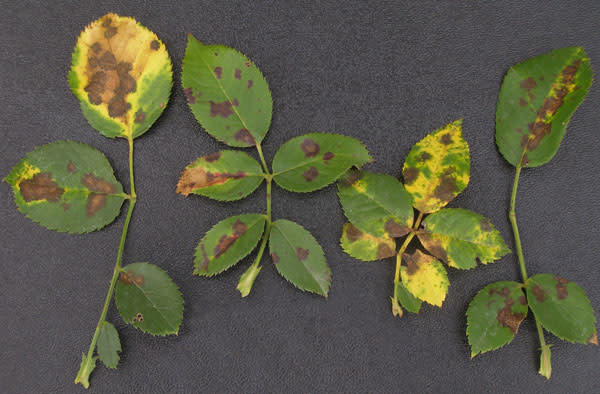
  • Small brown to black leaf spots outlined with feathery, irregular borders appear.
  • Spots may occur on either side of the leaves and on the canes, but usually show up on the upper leaf surfaces.
  • As the disease progresses, chlorotic (yellow) rings develop around each spot,growing and merging and eventually causing the entire leaf to yellow before dropping prematurely (Fig. 1).
  • Symptoms first appear on the lower plant parts, advancing upward until the roses become completely defoliated.
  • The fungus does not kill infected roses outright, but the repeated loss of leaves weakens them so they produce fewer blooms and are generally less healthy.
  • The fungus also makes the plant vulnerable to other stresses such as secondary infection by other diseases, adverse or extreme environmental conditions, and winter injury.


Control

  • Clean up dead leaves and prune infected canes to help reduce inoculum for the next season.
  • Plant varieties that are resistant to the disease.
  • Use watering practices that lessen leaf wetness since D. rosae spores need moisture to germinate and infect the plant. Promote rapid drying of the leaves by avoiding overhead watering and watering in early to mid-morning.
  • Encourage good air circulation and prevent the spread of the disease to adjacent plants by not planting too densely and by planting roses in full sun.
  • Prune and dispose of damaged and infected plant parts and remove infected canes and leaf litter to prevent re-infestation the following spring.
  • Fungicides are available to help manage black spot. Conventional (products containing
  • chlorothalonil, propacanazole or myclobutanil) or natural (products containing neem) fungicides are effective when used appropriately. Refer to product labels for proper rates and use.
Add your review
0 stars based on 0 reviews
Information

Black spot is one of the most common and destructive rose diseases that we see in Texas. Some roses are resistant to the disease but all species and cultivar are affected. Defoliation, decreased quality and quantity of blooms, and increased susceptibility to other stresses reduce overall plant health and cause significant losses to roses.
 

Symptoms

  • Small brown to black leaf spots outlined with feathery, irregular borders appear.
  • Spots may occur on either side of the leaves and on the canes, but usually show up on the upper leaf surfaces.
  • As the disease progresses, chlorotic (yellow) rings develop around each spot,growing and merging and eventually causing the entire leaf to yellow before dropping prematurely (Fig. 1).
  • Symptoms first appear on the lower plant parts, advancing upward until the roses become completely defoliated.
  • The fungus does not kill infected roses outright, but the repeated loss of leaves weakens them so they produce fewer blooms and are generally less healthy.
  • The fungus also makes the plant vulnerable to other stresses such as secondary infection by other diseases, adverse or extreme environmental conditions, and winter injury.


Control

  • Clean up dead leaves and prune infected canes to help reduce inoculum for the next season.
  • Plant varieties that are resistant to the disease.
  • Use watering practices that lessen leaf wetness since D. rosae spores need moisture to germinate and infect the plant. Promote rapid drying of the leaves by avoiding overhead watering and watering in early to mid-morning.
  • Encourage good air circulation and prevent the spread of the disease to adjacent plants by not planting too densely and by planting roses in full sun.
  • Prune and dispose of damaged and infected plant parts and remove infected canes and leaf litter to prevent re-infestation the following spring.
  • Fungicides are available to help manage black spot. Conventional (products containing
  • chlorothalonil, propacanazole or myclobutanil) or natural (products containing neem) fungicides are effective when used appropriately. Refer to product labels for proper rates and use.
Reviews (0)
0 stars based on 0 reviews
Add your review
Share
Tags

Related products

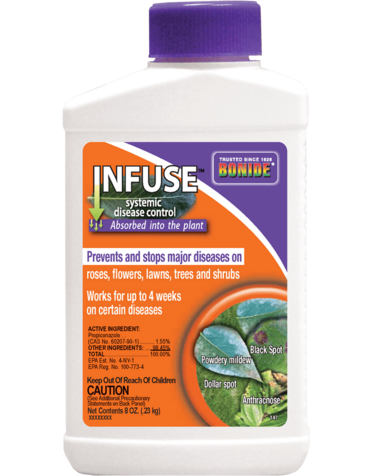
  • BONIDE, 'INFUSE CONC. 16 oz.
    BONIDE, 'INFUSE CONC. 16 oz.
    $14.99
    Add to cart
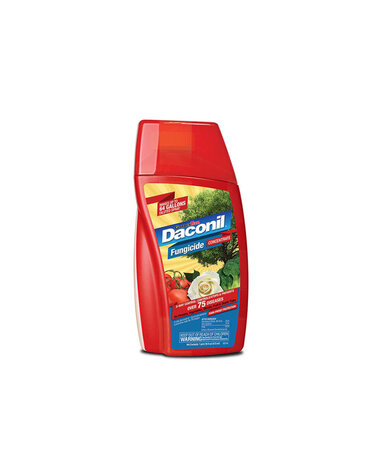
  • DACONIL, 'FUNGICIDE CONCENTRATE' 16OZ
    DACONIL, 'FUNGICIDE CONCENTRATE' 16OZ
    $18.99
    Add to cart
Follow us :
Customer service
  • Who We Are
  • Holds and Reservations Policy
  • Disclaimer
  • Privacy policy
  • Shipping & returns
  • Customer support
  • Sitemap
  • Plant Guarantee
  • Fall Lawn Fertilizers and Disease Products
Products
  • All products
  • New products
  • Offers
  • Tags
  • RSS feed
My account
  • Register
  • My orders
  • My wishlist
Growers Outlet
11173 Tx Hwy 75N. Willis, Texas 77378
(936)856-5001
[email protected]
© Copyright 2026 The Growers Outlet - Powered by Lightspeed
Credit Card
Hide Tutorial